Exploring the night sky is one of the most fascinating hobbies anyone can start, and having the Best Goto Telescope for Beginners makes the experience even more rewarding.
For beginners, GoTo telescopes are among the best options because they use computerized technology to locate and track celestial objects automatically.
Instead of spending hours searching for planets or star clusters, users can simply select a target and let the telescope point to it.
Popular beginner models like the Celestron NexStar 130SLT and Celestron NexStar 6SE make stargazing easier, allowing newcomers to quickly enjoy stunning views of the Moon, planets, and deep-sky objects.
“This post contains affiliate links. If you purchase through these links, I may earn a small commission at no extra cost. Learn more here.”
| 1) Sky‑Watcher 130P AZ‑GTi Wi‑Fi GoTo Reflector Telescope | 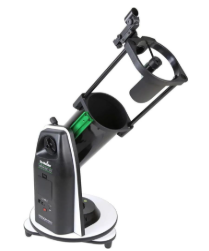 |
|
| 2) Celestron NexStar 130SLT |  |
|
| 3) Celestron NexStar 4SE |  |
|
| 4) Celestron NexStar 6SE |  |
What Is a GoTo Telescope and How Does It Work?
A GoTo telescope is a computerized telescope that may automatically find and follow astronomical objects in the night sky.
Contrary to the normal manual telescopes, where the user has to locate the object on his or her own, a GoTo system employs motors, sensors, and a built-in database to align the telescope to a couple of targets like planets, galaxies, nebulae, and star clusters.
This is particularly helpful when beginners do not know how to find their way around the night sky. The majority of GoTo telescopes have a computerized mount and a hand controller or mobile application.
Once the telescope is turned on, the user goes through a rapid process of aligning the telescope before the telescope can analyze its position in relation to the sky. This is known as the process of alignment.
In the process of alignment, the user aligns the telescope with two or three bright stars or heavenly bodies. After the confirmation of these reference points, the system computes the orientation of the telescope and is then prepared to use it.
Once the telescope has been aligned, the database in the telescope, which may consist of thousands or even tens of thousands of celestial objects, is available via the controller.
It is simple enough that the user just has to choose an item in the list, and the telescope will automatically slew (move) to the item and maintain it in the middle as the Earth turns.
This automatic tracking enables viewers to have longer viewing programs without having to keep moving the telescope.
Why Beginners Should Choose a GoTo Telescope
Beginners should choose a GoTo telescope because it makes stargazing much easier and more enjoyable. Unlike manual telescopes that require users to locate objects themselves, GoTo telescopes automatically find and track celestial targets using a computerized system.
This allows new astronomers to quickly observe planets, star clusters, nebulae, and galaxies without learning complex sky navigation.
Popular beginner models like the Celestron NexStar 130SLT and Celestron NexStar 6SE include large object databases and simple alignment systems.
As a result, beginners can spend more time observing the night sky and less time searching for objects.
What Can You See With a Beginner GoTo Telescope?
A beginner GoTo telescope can reveal a wide variety of fascinating celestial objects, even from a backyard. Because these telescopes automatically locate and track targets, beginners can quickly explore the night sky without needing advanced astronomy skills.
Popular beginner models like the Celestron NexStar 130SLT and Celestron NexStar 6SE allow users to observe both planetary and deep-sky objects with impressive detail.
One of the most rewarding sights is the Moon. With a beginner GoTo telescope, you can clearly see craters, mountains, and large lava plains on the lunar surface. The detail is often so sharp that it feels like looking at a completely different world.
Planets are another highlight. You can observe Jupiter’s cloud bands and its four largest moons, as well as the famous rings of Saturn. Under good viewing conditions, you may also see Mars’ polar ice caps and surface markings, along with the phases of Venus.
Beginner GoTo telescopes also make it possible to explore deep-sky objects.
These include bright nebulae such as the Orion Nebula, beautiful star clusters like the Pleiades, and even some distant galaxies like Andromeda.
While they may appear as faint patches of light rather than colorful images, seeing them through a telescope is still an exciting experience.
Best Goto Telescope for Beginners
1) Sky‑Watcher 130P AZ‑GTi Wi‑Fi GoTo Reflector Telescope
One of the most user-friendly computerized telescopes is the Sky-Watcher 130P AZ-GTi Wi-Fi GoTo Reflector Telescope that integrates rigorous optics with the new smartphone technology.
Has a 130 mm Newtonian reflector that has a parabolic primary mirror, which enables it to collect a lot of light in comparison with smaller scopes used by novice astronomers.
It is fitted to the AZ-GTi motorized GoTo mount capable of automatically finding and tracking heavenly objects via the SynScan mobile app on a smartphone or tablet.
User-friendly to beginners wishing to navigate all over the night sky without having to move their eyes to locate the targets, because of the wireless control.
Gives a good compromise between power and portability. The telescope has a 650 mm focal length with a fast f /5 focal ratio and, as such, has wide fields of view which are ideal for the observation of star clusters and nebulae.
The Wi-Fi GoTo system has the ability to look up a database of more than 10,000 celestial objects to enable the telescope to slew to targets automatically, like galaxies, nebulae, and star clusters.
Altogether, the Sky-Watcher 130P AZ-GTi is a good universal telescope for a person who is a beginner who wants to have the powerful but portable GoTo system.
Key Specifications
- Optical design: Newtonian reflector
- Aperture: 130 mm
- Focal length: 650 mm
- Focal ratio: f/5
- Mount: AZ-GTi computerized GoTo Alt-Az mount
- Database: 10,000+ celestial objects
- Eyepieces included: 25 mm and 10 mm (1.25″)
- Highest practical magnification: ~260×
- Control: Wi-Fi via SynScan smartphone app
Pros
- Good 130 mm aperture for planets and deep-sky objects
- Wi-Fi GoTo control via smartphone or tablet
- Automatic tracking of celestial objects
- Portable and relatively lightweight
- Wide-field views thanks to fast f/5 optics
Cons
- Requires batteries or an external power supply
2) Celestron NexStar 130SLT
Celestron NexStar 130SLT is popularly regarded as one of the best GoTo telescopes among beginners since it has good optical power and a fully computerized mount.
The telescope has a 130 mm Newtonian reflector with a parabolic primary mirror that enables the telescope to gather significantly more light than small beginner telescopes.
Consequently, it is able to display in-depth images of the craters of the Moon and rings of Saturn along with cloud bands in Jupiter and moons of Jupiter, and most of the deep-sky objects, including star clusters and bright nebulae.
Another important aspect of this telescope is the GoTo system that is designed to be computerized. The telescope is capable of automatically tracking and locating over 40000 celestial objects in its database using the NexStar+ hand controller.
Has an optical design of a 650 mm focal length and f/5 focal ratio, which give it wide fields of view, which are useful in scanning the night sky.
It possesses two eyepieces (25 mm and 9 mm) which have magnifications of approximately 26 x and 72 x where beginners can view extensive star fields as well as detailing the planetary ones. It has an Alt-Az motorized mount that tracks objects in the eyepiece at varying rates as the Earth turns.
Key Specifications
- Optical design: Newtonian reflector
- Aperture: 130 mm (5.1 in)
- Focal length: 650 mm
- Focal ratio: f/5
- Mount type: Computerized Alt-Az GoTo mount
- Object database: 40,000+ objects
- Eyepieces included: 25 mm and 9 mm
- Highest useful magnification: ~307×
- Tracking rates: Sidereal, solar, and lunar
Pros
- Large 130 mm aperture for bright planetary and deep-sky views
- Computerized GoTo system with 40,000+ objects
- Beginner-friendly SkyAlign setup
- Portable and quick no-tool assembly
- Wide-field views thanks to fast f/5 optics
Cons
- Requires AA batteries or external power
3) Celestron NexStar 4SE
The Celestron NexStar 4SE is a classic and very popular GoTo telescope for beginners thanks to its elegant combination of quality optics, automated tracking, and user‑friendly design.
At its heart is a 102 mm Maksutov‑Cassegrain optical tube, a compact catadioptric design that delivers crisp, high‑contrast views of the Moon, planets like Jupiter and Saturn, and brighter deep‑sky objects.
Its long 1325 mm focal length (f/13) produces detailed planetary views with good image clarity, making it ideal for beginners who want rewarding views without complicated setup.
One of the NexStar 4SE’s biggest strengths is its computerized GoTo mount with a database of over 38,000 celestial objects.
Once you perform the easy SkyAlign setup, the telescope will automatically locate and track objects as the night sky shifts—a huge help for newcomers who aren’t yet familiar with star‑hopping.
Its signature single fork arm mount and sturdy tripod break down into compact components, so it’s portable enough for backyard observing and trips to dark‑sky sites, though it isn’t the lightest scope out there.
Beginners appreciate that setup is generally quick and straightforward, and that the scope includes essential accessories like a 25 mm eyepiece and StarPointer red‑dot finder to get you started right away.
Key Specifications
- Optical design: Maksutov‑Cassegrain
- Aperture: 102 mm (4″)
- Focal length / ratio: 1325 mm, f/13
- Mount: Computerized Alt‑Az GoTo single‑fork
- Object database: ~38,000 celestial targets
- Eyepiece included: 25 mm (≈53×)
- Power: 8× AA batteries or 12 V DC
- Weight (assembled): ~23 lb (10.4 kg)
Pros
- Great optics for detailed lunar and planetary views
- Automated GoTo tracking with large object database
- Easy SkyAlign setup helps beginners get observing quickly
- Solid build quality and portable design
Cons
- Narrow field of view compared with wider‑scope designs
4) Celestron NexStar 6SE
Celestron NexStar 6SE is an outstanding entry-level GoTo telescope that occupies the void between the simple entry-level telescopes and the high-end ones.
Has a 6-inch (150mm) Schmidt-Cassegrain optical tube, a traditional design, which is efficient in folding the light to present clear and sharp images of the Moon, planets such as Jupiter and Saturn, and brighter deep-sky objects such as nebulae and star clusters.
Its aperture and very long focal length (1500mm f/10) are relatively large; thus, it can be used to observe in detail planets, as well as, to a limited extent, the deep-sky.
SkyAlign technology makes it easy to find alignment, and you just need to center three bright heavenly bodies in the eyepiece, and the system will calculate where the device is pointed, so it can be used even when you are not an astronomer.
Portable, and is fairly compact, with a power source, which can be disassembled to be easily transported to darker skies or stored away when not in use. It has a strong tripod and mount, which makes it move well and view accurately.
Key Specifications
- Optical design: Schmidt‑Cassegrain
- Aperture: 150 mm (6″)
- Focal length/focal ratio: 1500 mm, f/10
- Mount: Computerized Alt‑Az single fork GoTo
- Object database: 40,000+ targets
- Eyepiece included: 25 mm (≈60×)
- Tracking: Automatic GoTo tracking
- Power: 8 AA batteries or external 12 V DC
Pros
- Large 6″ aperture gathers plenty of light for detailed views of planets and brighter deep‑sky objects
- Computerized GoTo with SkyAlign makes object locating easy
- Portable and compact design compared to larger telescopes
- Extensive object database keeps exploration interesting for years
Cons
- Battery life can be short if using AA batteries alone
Factors to Consider When Choosing The Best Goto Telescope for Beginners
Choosing the best GoTo telescope as a beginner can make a huge difference in how enjoyable and successful your stargazing experience will be.
- Aperture Size
One of the most significant features is the apperture (diameter of the main mirror or lens of a telescope). The bigger the aperture, the more light is collected and thus you are able to see dimmer objects and finer details.
As a beginner, the telescopes with the apertures of between 102mm-150mm present an ideal compromise between the performance and price.
The bigger apertures are ideal in terms of viewing planets, nebulae, and galaxies whereas small apertures are easy to carry around.
- Optical Design
Various optical designs have diverse benefits. The next type are newtonian reflectors which are typically cheaper and offer large fields of view, which is useful when searching nebulae and star clusters.
The telescopes that are smaller are called Schmidt Cassegrain and Maksutov Cassegrain telescopes that offer high contrast sharper images which are best suited to the observation of the planet.
- GoTo System and Object Database.
An excellent GoTo telescope must possess a dependable computerized mount and a large object database.
Most modern systems have tens of thousands of heavenly bodies and beginners can access the planets, galaxies and star clusters fast.
Similar features such as easy alignment tools such as SkyAlign or smartphone applications can make the process a lot easier to new users.
- Portability and Setup
A lightweight and easy-to-assemble telescope is a typical advantage to beginners. Portable designs are more useful and can be carried to darker places of observation where the night sky is clearer.
- Mount Stability and Tracking.
A smooth automatic tracking provides a stable mount where objects are held in the eyepiece during the rotation of the earth.
This comes in particularly handy when viewing highly with a high magnification or sharing with other persons.
- The Accessories and the Power Options.
Essential accessories like eyepieces, finderscopes, and tripods among others can be included to supplement the observing experience.
Another aspect that should be taken into consideration is the powering of the telescope, as the majority of GoTo systems need to have batteries or external power.
FAQs
- What is a GoTo telescope?
A GoTo telescope is a computerized telescope that automatically finds and tracks celestial objects in the night sky.
After a simple alignment process, the telescope can locate planets, galaxies, nebulae, and star clusters using a built-in database.
Popular beginner models like the Celestron NexStar 130SLT and Celestron NexStar 6SE make stargazing easier because you don’t need to manually search for objects.
- Are GoTo telescopes good for beginners?
Yes. GoTo telescopes are excellent for beginners because they automatically point to objects and track them as the Earth rotates.
This reduces frustration and allows new astronomers to focus on observing rather than learning complicated star-hopping techniques.
- What can you see with a beginner GoTo telescope?
With a beginner GoTo telescope you can see many impressive celestial objects, including:
- The Moon’s craters and mountains
- Jupiter’s cloud bands and moons
- Saturn’s rings
- Bright nebulae like Orion
- Star clusters and some galaxies
Telescopes such as the Celestron NexStar 4SE or Sky‑Watcher 130P AZ‑GTi Wi‑Fi GoTo Reflector Telescope are capable of showing hundreds of objects from dark skies.
- Do GoTo telescopes require internet or Wi-Fi?
Most GoTo telescopes do not require internet access to operate. The object database is stored in the telescope’s hand controller.
However, some models include Wi-Fi connectivity for smartphone control through astronomy apps.
Final Thoughts
Choosing the best GoTo telescope for beginners depends on factors such as aperture size, portability, ease of use, and budget. A good beginner telescope should provide clear views while also being simple to set up and operate.
With the right GoTo telescope, beginners can easily explore planets, star clusters, nebulae, and galaxies while developing a deeper appreciation for the wonders of the universe.
Also check out: 5 Best Smart Telescope for Planets