Exploring the night sky can be a thrilling experience, but for beginners, finding the best computerized telescope for planets, star clusters, and distant galaxies can feel overwhelming.
This is where computerized telescopes, also known as GoTo telescopes, become invaluable. Unlike traditional manual telescopes, these beginner-friendly devices use motorized mounts and built-in databases to locate and track thousands of celestial objects automatically.
Modern computerized telescopes, such as the Celestron NexStar 5SE or Orion StarSeeker IV 130mm, combine high-quality optics with automation, offering bright, detailed views of the Moon, planets, and even deep-sky objects.
Whether you’re observing from your backyard or a darker location, these telescopes make stargazing simple, engaging, and rewarding.
In this guide, we review the best computerized telescopes for beginners to help you choose the ideal model for your needs.
“This post contains affiliate links. If you purchase through these links, I may earn a small commission at no extra cost. Learn more here.”
| 1) Orion StarSeeker IV 130mm GoTo Telescope | 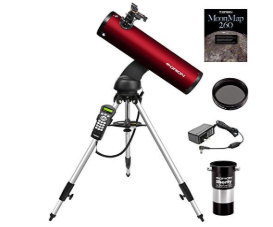 |
|
| 2) Celestron NexStar 5SE Computerized Telescope | 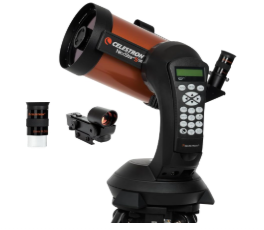 |
|
| 3) Celestron NexStar 6SE Computerized Telescope | 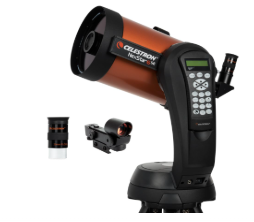 |
|
| 4) Celestron NexStar 130SLT Computerized Telescope | 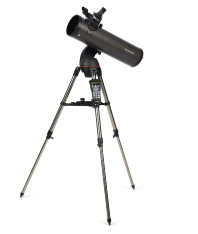 |
What Is a Computerized (GoTo) Telescope?
A computerized (GoTo) telescope is a type of telescope that uses a built-in computer and a motorized mount to track and locate celestial bodies in the night sky.
Once the telescope has been oriented so that it is aiming at a few bright stars, the computer in the telescope refers to its internal database to locate the locations of thousands of astronomical objects.
After alignment, the user chooses an object like a planet, cluster of stars, nebula, or galaxy in the controller of the telescope, or a corresponding smartphone app.
Then the telescope automatically swivels (or switches to) the situated object and holds this object at the center of the eyepiece as the Earth rotates.
Benefits of Using a Computerized Telescope
- Automatic Object Location
The GoTo system can automatically locate thousands of celestial objects such as planets, stars, galaxies, and nebulae.
- Easy to Use for Beginners
Computerized telescopes simplify stargazing by removing the need to manually search for objects in the night sky.
- Automatic Tracking
Once an object is found, the telescope tracks it as the Earth rotates, keeping it centered in the eyepiece for longer observation.
- Large Object Databases
Many computerized telescopes include built-in databases with thousands or even tens of thousands of celestial objects.
- Time-Saving
Instead of spending time locating objects manually, users can quickly select targets using the hand controller or a mobile app.
- Better Learning Experience
Beginners can learn about the night sky more easily by exploring different celestial objects with guided navigation.
- Improved Viewing Sessions
Automatic tracking allows observers to spend more time studying objects rather than constantly adjusting the telescope.
- Compatibility with Apps and Accessories
Some modern computerized telescopes can connect to smartphones, astronomy apps, and cameras, making them more versatile for observing and basic astrophotography.
Best Computerized Telescope for Beginners
1) Orion StarSeeker IV 130mm GoTo Telescope
Orion StarSeeker IV 130mm GoTo Telescope is a computerized reflector telescope that was aimed at beginners who are interested in exploring the night sky with ease.
It has a 130 mm (5-inch) aperture (optical) designed to use a Newtonian reflector design and to have a high light-gathering capacity as well as enable the user to view bright planets, the Moon, star clusters, and selected deep-sky objects, including nebulae and galaxies.
The telescope has a motorized GoTo mount, which automatically points and tracks the sky objects once a simple alignment procedure is done.
After alignment, the system has the ability to point the telescope to thousands of objects in the database, which is contained in it, and the ease of locating objects in the sky for beginners is enhanced.
Also has a SynScan GoTo package and a database of over 42, 000 celestial bodies. Once an object has been chosen, the mount automatically rotates and follows the object, ensuring it remains in the eyepiece to allow extended viewing.
Key Specifications
- Optical design: Newtonian reflector
- Aperture: 130 mm (5 in)
- Focal length: 650 mm
- Focal ratio: f/5
- Mount: Motorized alt-azimuth GoTo mount
- Database: ~42,000 celestial objects
- Maximum useful magnification: ~260×
- Included eyepieces: 10 mm and 23 mm
- Weight (complete setup): about 9–10 kg
Pros
- Computerized GoTo system automatically finds objects
- Large 130 mm aperture for bright views
- Wide-field optics suitable for deep-sky objects
- Automatic tracking keeps objects centered
- Good balance between power and portability
Cons
- Requires a power supply or batteries for the GoTo system
2) Celestron NexStar 5SE Computerized Telescope
The Celestron NexStar 5SE Computerized Telescope, which has become one of the most favored computerized telescopes by beginners who wish to have a balance between a computerized telescope, portability, and automation.
It employs a Schmidt-Cassegrain optical design that is an amalgamation of one mirror and lenses to crank out sharp and high contrast images at the same time, making the telescope compact.
Has an aperture of 125 mm (5 inches), which collects sufficient light to see the craters on the Moon, rings around Saturn, assigns of cloud on Jupiter, and numerous bodies of the deep sky, including star clusters and bright nebulae.
Fully computerized GoTo mount, which can find and follow the celestial objects automatically after pointing the telescope at the night sky.
SkyAlign technology eases the process of setting up the telescope as it enables users to adjust the telescope with the help of three bright celestial objects that are bright.
Key Specifications
- Optical design: Schmidt-Cassegrain
- Aperture: 125 mm (4.92 in)
- Focal length: 1250 mm
- Focal ratio: f/10
- Mount: Computerized single-fork alt-azimuth GoTo mount
- Database: ~38,000 celestial objects
- Highest useful magnification: ~295×
- Included eyepiece: 25 mm (50× magnification)
- Total weight: ~8 kg (17.6 lb)
Pros
- Fully automated GoTo system makes locating objects easy
- Compact design with powerful optics
- Excellent for observing the Moon and planets
- Large object database with automatic tracking
- Portable and relatively easy to set up
Cons
- More expensive than many beginner telescopes
3) Celestron NexStar 6SE Computerized Telescope
The Celestron NexStar 6SE Computerized Telescope has been among the most recommended computerized telescopes to beginners and intermediate-level astronomy enthusiasts.
It is characterized by a Schmidt-Cassegrain optical design that incorporates the use of mirrors and lenses to provide images that are sharp and, at the same time, make the telescope small and lightweight.
Has a 150 mm (6-inch) aperture, enabling the observer to see the craters on the Moon, rings around Saturn, clouds on Jupiter, and numerous deep-sky objects (nebulae, star clusters, and galaxies).
Key strengths of the NexStar 6SE are the fully automated GoTo telescope mount with a computerized database on more than 40,000 celestial objects.
Once the telescope is set in place with the SkyAlign technology, one can choose an object through the hand controller, and the telescope automatically swivels to that object and follows it as it rotates in the sky.
This characteristic renders it particularly easy-going to beginners since there is no necessity that the person should be well versed in the locations of stars.
It also comes with a heavy steel tripod and a one-fork arm mount that is simple to set up and carry, and therefore, can be used in both backyard watching and visiting dark sky sites.
Key Specifications
- Optical design: Schmidt-Cassegrain
- Aperture: 150 mm (5.9 in)
- Focal length: 1500 mm
- Focal ratio: f/10
- Mount: Computerized single-fork alt-azimuth GoTo mount
- Object database: 40,000+ celestial objects
- Highest useful magnification: ~354×
- Included eyepiece: 25 mm (about 60× magnification)
- Optical coatings: StarBright XLT
- Total weight: about 9–12 kg, depending on configuration
Pros
- Powerful 6-inch aperture provides bright and detailed views
- Fully computerized GoTo system makes locating objects easy
- Large 40,000-object database
- Compact design with strong optical performance
- Portable and relatively easy to assemble
Cons
- More expensive than basic beginner telescopes
4) Celestron NexStar 130SLT Computerized Telescope
The Celestron NexStar 130SLT Computerized Telescope is a computerized telescope that is easy to use in order to help the beginner learn and enjoy exploring the night sky.
It has a Newtonian reflector optical structure with an aperture of 130 mm (5-inch), which enables it to receive a lot of light and give bright images of celestial bodies.
This causes it to be able to demonstrate extensive lunar characteristics, rings of Saturn, the bands of clouds of Jupiter, as well as numerous deep-sky objects like nebulae and clusters of stars.
It has a focal length of 650 mm and a focal ratio of f/5 to offer wide-field views, which come in handy when it is required to view wider areas of the sky.
One of the better qualities of the telescope is the computerized GoTo mount operated through the NexStar hand controller.
Thousands of celestial objects can be automatically detected and followed by the system after a simple procedure of their alignment.
Portable with its lightweight optical tube and motorized mount, which can be carried around or used in the backyard to observe the universe, or even when the user is visiting darker places of observation.
Key Specifications
- Optical design: Newtonian reflector
- Aperture: 130 mm (5.12 in)
- Focal length: 650 mm
- Focal ratio: f/5
- Mount: Computerized single-fork alt-azimuth GoTo mount
- Database: 4,000+ objects (expandable)
- Highest useful magnification: ~307×
- Included eyepieces: 25 mm and 9 mm
- Finder: StarPointer red-dot finder
- Light-gathering power: About 345× the human eye
Pros
- Computerized GoTo system automatically locates objects
- Large 130 mm aperture provides bright views of planets and deep-sky objects
- Wide-field optics ideal for star clusters and nebulae
- Lightweight and portable for beginners
- Includes useful accessories and automated tracking
Cons
- Mount can be slightly less stable at high magnification
Factors to Consider When Choosing The Best Computerized Telescope for Beginners
These factors help beginners choose a telescope that provides clear views of celestial objects while also being practical to set up and operate.
- Aperture (Light-Collecting Power)
Aperture is the size of the telescope’s main lens or mirror, which is among the most significant aspects of the telescope’s performance.
A higher aperture gives the telescope an opportunity to collect more light, which creates brighter and sharper images of heavenly bodies.
To start with, a dual core like the Celestron NexStar 6SE Computerized Telescope or Celestron NexStar 130SLT Computerized Telescope of between 100 mm and 150 mm is a good average between viewing strength and cost.
- Computerized GoTo System
The GoTo system is one of the important characteristics of computerized telescopes, and this system tracks the objects of the sky and locates them automatically once the telescope is aligned.
A large object database in a telescope enables a novice to easily navigate through the sights of planets, galaxies, and star clusters without having to have a lot of knowledge about the night sky.
Such telescopes as Orion StarSeeker IV 130mm GoTo Telescope have databases with tens of thousands of objects, and exploring the sky becomes easier.
- Optical Design
Various telescopes are designed with various reflecting optical designs, such as either Newtonian or Schmidt-Cassegrain.
Reflector telescopes are usually wide-field telescopes that are good value, and Schmidt-Cassegrain telescopes are small and sharp in image.
- Portability and Size
The small optical tube models are lightweight and fit perfectly in the backyard, where they are able to see the stars, or when traveling to the dark sky areas.
FAQs
- What is a computerized telescope?
A computerized telescope is a telescope equipped with a motorized mount and a GoTo system that can automatically locate and track celestial objects. After a simple alignment process, the telescope moves to selected objects such as planets, stars, and galaxies from its built-in database.
- Are computerized telescopes good for beginners?
Yes. Computerized telescopes are very helpful for beginners because they automatically find objects in the night sky. Instead of manually searching for stars and planets, users can simply select an object from the controller, and the telescope will point to it.
- What aperture size is best for beginners?
For beginners, an aperture between 100 mm and 150 mm is usually ideal. This size gathers enough light to clearly view the Moon, planets, and many deep-sky objects while still keeping the telescope portable and easy to use.
- Do computerized telescopes require power?
Yes. Most computerized telescopes require batteries or an external power source to operate the motors and GoTo system. Some models can use rechargeable power tanks or AC adapters for longer observation sessions.
- How difficult is it to set up a computerized telescope?
After assembling the tripod and telescope, users typically perform a simple alignment process using bright stars before the GoTo system becomes fully operational.
Final Thoughts
Choosing the right computerized telescope can transform your stargazing experience, especially if you are just starting in astronomy.
Telescopes like the Celestron NexStar 6SE, NexStar 5SE, and Orion StarSeeker IV 130mm offer a perfect balance of performance, portability, and ease of use.
Investing in a computerized telescope not only simplifies observing but also encourages learning and exploration, making astronomy more enjoyable and accessible.
Also check out: 4 Best Goto Telescope for Beginners