Capturing the delicate spiral arms of a distant galaxy or the glowing core of Andromeda is one of the most rewarding experiences in astrophotography. But achieving those breathtaking deep-sky images starts with choosing the Best Telescope for Galaxy Astrophotography.
Galaxies are faint, often small targets that demand strong light-gathering power, precise tracking, and well-corrected optics. The wrong setup can lead to frustration, while the right one can unlock stunning detail and dramatically improve your results.
In this guide, we’ve carefully selected and compared some of the best telescopes for galaxy astrophotography from fast Newtonian astrographs to premium apochromatic refractors and advanced Schmidt-Cassegrain systems.
Whether you’re just starting or looking to upgrade to a more powerful imaging platform, this article will help you understand the key differences, strengths, and trade-offs so you can invest confidently in a telescope that matches your skill level, budget, and imaging goals.
“This post contains affiliate links. If you purchase through these links, I may earn a small commission at no extra cost. Learn more here.”
| 1) Celestron EdgeHD 11″ Schmidt-Cassegrain | 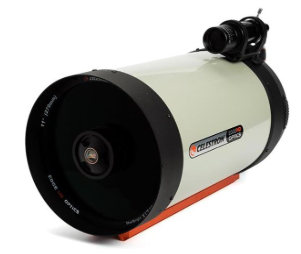 |
|
| 2) Celestron Origin Mark II Intelligent Home Observatory | 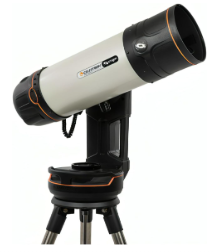 |
|
| 3) Sky-Watcher Esprit 100ED APO Refractor | 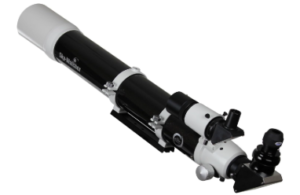 |
|
| 4) Sky-Watcher Quattro 200P Imaging Newtonian | 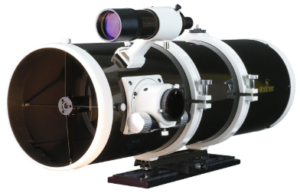 |
|
| 5) Sky-Watcher Quattro 150P f/4 Astrograph | 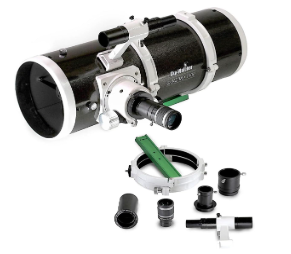 |
|
Comparison Table
| Feature / Telescope | Celestron EdgeHD 11″ Schmidt‑Cassegrain | Celestron Origin Mark II Intelligent Home Observatory | Sky‑Watcher Esprit 100ED APO Refractor | Sky‑Watcher Quattro 200P Imaging Newtonian | Sky‑Watcher Quattro 150P f/4 Astrograph |
|---|---|---|---|---|---|
| Optical Design | Schmidt-Cassegrain w/EdgeHD correction | RASA + integrated camera & electronics | Apochromatic triplet refractor | Parabolic Newtonian | Parabolic Newtonian |
| Aperture | 279 mm | 152 mm | 100 mm | 205 mm | 150 mm |
| Focal Length | 2800 mm | 335 mm | 550 mm | 800 mm | 600 mm |
| Focal Ratio | f/10 (native) | f/2.2 | f/5.5 | f/4 | f/4 (≈f/3.45 with corrector) |
| Field of View | Narrow | Very wide | Wide | Wide | Very wide |
| Built-in Camera | No | Yes (Sony IMX678 STARVIS 2) | No | No | No |
| Best For | Detailed small targets, deep galaxies at high resolution | Quick, automated wide-field deep-sky imaging | Color-accurate wide fields | Fast deep-sky wide views | Fast wide-field imaging on APS-C/full-frame |
| Portability | Heavy | Medium / All-in-one | Light | Medium | Light |
| Mount Needed | Yes, robust equatorial | Self-contained alt-az | Yes, tracking EQ | Yes, tracking EQ | Yes, tracking EQ |
| Ease of Use | Advanced | Beginner-friendly | Intermediate | Intermediate | Intermediate |
| Pros | Excellent, sharp field, versatile focal options | Fully automated imaging, real-time stacking | Excellent color correction, flat field | Fast imaging, great light gathering | Fast optics, coma corrector included |
| Cons | Expensive, requires a strong mount | Less manual control, tech reliance | Smaller aperture limits faint detail | Requires collimation, no mount included | Requires precise collimation, needs EQ mount |
Best Telescope for Galaxy Astrophotography
1) Celestron EdgeHD 11″ Schmidt-Cassegrain
The Celestron EdgeHD 11″ Schmidt‑Cassegrain Telescope is one of the most capable telescopes for galaxy astrophotography, blending high-end optics with a design that supports deep-sky imaging at an advanced level.
Features an optical tube that has a long focal length of 2800 mm at f/10 and a light-gathering capacity and resolution capability to view galaxies, nebulae, star clumps, and planetary targets in detail.
EdgeHD optical system, unlike a typical SCT, has corrective optics to flatten the focal plane and radius the focal plane and coma, that is, make the stars sharp and round even at the corners of the imaging field, an important feature when taking astrophotography with a large sensor.
This telescope is a good one in both its original focal ratio and with accessories for astrophotographers. A 0.7x focal reducer reduces the system to approximately f/7, broadening the field of view and reducing the exposure time needed on deep-sky objects.
It can also be used with fast imaging adapters such as HyperStar which can make the tube an ultra-fast f/1.9 system, optimal in wide nebulae and galaxy mosaics.
Has in-house mirror lock and cooling vents to enhance the stability of focus and minimise thermal gradients, and a high-quality StarBright XLT coating that maximises the light throughput.
These features provide sharp, high-contrast camera images with a wide field at native f/10 on a full-frame camera.
Key Specifications
- Optical design: EdgeHD Schmidt-Cassegrain
- Aperture: 279 mm (11 in)
- Focal length: 2800 mm (f/10)
- Flat field optics: Yes (EdgeHD corrective system)
- ncluded accessories: 23 mm Axiom eyepiece, 9×50 finderscope, 2″ diagonal (tube-only versions vary)
- Weight: ~28 lbs (OTA)
- Field performance: Diffraction-limited stars to the edge of large sensors
Pros
- Outstanding image quality with a flat, coma-free field across large sensors
- Versatile imaging options, from native f/10 to faster regimes with reducers or HyperStar.
- High light-gathering power and resolution, revealing fine detail in galaxies and nebulae.
- Solid mechanical features like mirror locks and cooling vents improve imaging stability.
Cons
- Heavy and large
2) Celestron Origin Mark II Intelligent Home Observatory
The Celestron Origin Mark II Intelligent Home Observatory is a very new, smart telescope that is specifically crafted to be an easy-to-use deep-sky and galaxy astrophotography telescope with high-end optics and automated imaging technology to suit beginner/intermediate astronomers.
It is a single system all-in-one AI-enhanced astrophotography in a 6-inch Rowe-Ackermann Schmidt Astrograph (RASA) optical tube with a focal ratio of f/2.2 and a short 335 mm focal length, providing it with a wide field of view and sharp images of galaxies, nebulae, and large star clusters without having to use long individual exposures.
This telescope is unique in that it has an inbuilt camera and smart processing: a Sony IMX678 STARVIS 2 CMOS sensor (in itself 8.3 MP, or around 8.3 Megapixels) can take detailed color images with reduced noise, and its onboard AI-based stacking and enhancement continually improve images as they appear on the screen.
All you do is pick a target in the companion application, and the system will automatically match, get in focus, follow, and accumulate the image – you do not need any additional guide cameras, laptops, or manual stacking.
The telescope is mounted on a computerized alt-azimuth fork with an inbuilt rechargeable battery and wireless control, and therefore has minimum set up: power on, connect your tablet or phone via Wi-Fi, select a deep-sky object, and see detail in real time.
Also has the inbuilt filter drawer to apply imaging filters, autofocus, and dew system- all featuring to be able to simplify deep-sky imaging.
Key Specifications
- Optical design: Rowe-Ackermann Schmidt Astrograph (RASA)
- Aperture: 152 mm (6″)
- Focal length: 335 mm
- Focal ratio: f/2.2
- Camera: Sony IMX678 STARVIS 2 CMOS (≈8.3 MP)
- Resolution: ~1.48 arcsec/pixel
- Field of view: ~1.32° × 0.75°
- Mount: Computerized alt-azimuth with built-in battery & Wi-Fi
- Integrated features: Autofocus, dew control, filter drawer, AI stacking & real-time processing
Pros
- Easy astrophotography: Automated setup, alignment, and smart stacking make deep-sky imaging simple even for beginners.
- Fast optics: Very bright f/2.2 system captures rich galaxy and nebula detail with short exposures.
- Integrated imaging: Built-in camera, computer, mount, and battery reduce extra gear needs.
- Real-time results: Live stacking and AI enhancement deliver detailed images you can view and share immediately.
Cons
- Limited manual control
3) Sky-Watcher Esprit 100ED APO Refractor
The Sky-Watcher Esprit 100ED APO Refractor is a deep-sky apochromatic refractor telescope with a wide range of admirers among the deep-sky imager community because of its extensive ability to capture wide fields of observation of galaxies and nebulae in astrophotography.
Features a 100 mm triplet apochromatic refractor with a 550 mm focal length and a bright f/5.5 focal ratio, which is suitable for taking large galaxies, clusters of stars, and nebulae in short to medium exposure times.
Its three-element air-spaced objective lens is usually designed with a premium quality low-dispersion (ED) glass element to fundamentally suppress false color (chromatic aberration) to the extent that it has sharp, high-contrast images with excellent color neutrality, a significant benefit in astrophotography.
An important astrophotography-friendly attribute is the fact that it has a 2-element field-flattener installed, which helps to correct field curvature so that stars remain round and sharp on a large imaging sensor. This is very important with the larger cameras.
Also has a rock-solid, 2-speed, Helinear Track, with a slight image shift, and this provides excellent control in focusing; this is essential when one wants to focus on a faint galaxy critically.
Mechanically, Esprit 100ED is manufactured with high-quality tube and accessories package consisting of an 8×50 right-angle finderscope, M48 camera adapter, and a padded case, which is a complete imaging-ready package.
Its size is relatively smaller, and therefore it can be easily mounted on a mid-range equatorial mount to allow the use of long exposures and stable tracking.
Key Specifications
- Optical design: Apochromatic triplet refractor
- Aperture: 100 mm
- Focal length: 550 mm
- Focal ratio: f/5.5
- Focuser: Dual-speed 3″ Helinear Track
- Field corrector/flattener: Included 2-element field flattener
- Finderscope: 8×50 right-angle
- Included adapters: M48 camera adapter, 2″ diagonal/adapter
- Weight: ~7.4 kg (tube alone)
Pros
- Excellent optical quality: Triplet ED lenses and high-transmission coatings provide superb sharpness and low chromatic aberration for astrophotography.
- Wide, flat imaging field: Field flattener yields round stars across the full sensor for large galaxies and nebulae.
- Smooth, precise focuser: Dual-speed focuser helps achieve critical focus and supports heavy cameras.
- Complete imaging-ready package: Comes with adapters, diagonal, and case — good value for astrophotographers.
Cons
- Sensor size limits
4) Sky-Watcher Quattro 200P Imaging Newtonian
The Sky-Watcher Quattro 200P Imaging Newtonian, a fast, operationally varied reflector telescope, is frequently suggested to be utilized in wide-field galaxy astrophotography due to its large aperture and fast optics.
Sky-Watcher Quattro 200P is an 8-inch (c. 205 mm) parabolic Newtonian reflector, a model designed to be used as an imager.
Its f/4 focal ratio and 800 mm focal length imply that it collects light much faster than most conventional telescopes and therefore has shorter exposures and still resolves distant galaxies, nebulae, and star clusters, which is a massive boon when observing deep-sky objects without very long subs.
Mechanically, the Quattro 200P is a 10:1 dual-speed machined 2″ Crayford focuser that offers smooth, precise control that is important in dial-in focusing a high-resolution camera.
Its oversized secondary mirror is to assist in completely illuminating APS-C and full-frame DSLR or CMOS sensors with minimal vignetting, and the mirrored surfaces are coated with Radiant™ Aluminum Quartz materials (average reflectivity of 94%).
Also, the optical tube assembly is supplied with simple accessories such as tube rings, dovetail plate, 9×50 finderscope, but, most notably, no mount, hence you would need a stable equatorial tracking mount in order to achieve successful long exposures.
Key Specifications
- Optical design: Newtonian reflector
- Aperture: 205 mm (8″)
- Focal length: 800 mm
- Focal ratio: f/4
- Focuser: 2″ dual-speed Crayford (10:1)
- Mirror coatings: Radiant™ Aluminum Quartz
- Finder: 9×50 finderscope included
- Weight: 9 kg (OTA with accessories)
Pros
- Fast optics: f/4 system captures bright deep-sky images with shorter subs, ideal for galaxies and wide nebulae.
- Large light-gathering aperture: The 8″ mirror brings in abundant light for faint deep-sky objects.
- Sharp images across the field: Parabolic mirror and oversized secondary help deliver sharp detail to the edges, perfect for astrophotography.
- Precise focuser: Dual-speed focuser makes fine focus adjustments easier, which aids critical imaging.
- Good value: Great performance for astrophotography at a relatively affordable cost compared with many specialized astrographs.
Cons
- Mount not included
5) Sky-Watcher Quattro 150P f/4 Astrograph
The Sky-Watcher Quattro 150P f/4 Astrograph is a fast wide field Newtonian reflector that is well adapted to galaxy and deep-sky astrophotography, and that fits an imager who does not feel the need to have a too complex system.
Features a 150mm (6in) parabolic Newtonian astrograph that has been made with a ground-up design, aimed at imaging deep-sky sources, such as galaxies, nebulae, and large star clusters.
Has a f/4 focal ratio native and a focal length of 600 mm to provide a fast optical system, or in other words, one that can grab light in a short period so that you can be able to capture quality data in a shorter period of time.
Also has an aplanatic coma correcter which is equivalent to the focal length of 600 mm, which essentially corrects the imaging field and eliminates the coma that is characteristic of fast Newtonians.
The system operates at a focal length of about f/3.45 with the corrector in place, producing an even shorter effective imaging focal length and sharper stars to the edge of a sensor – perfect on APS-C and most full-frame cameras.
Mechanically, the Quattro 150P has a dual-speed 2-inch (Crayford) focuser (typically 10:1 or 11:1), allowing the process of dialing in critical focus without any difficulty, even with larger imaging cameras.
Its large secondary mirror serves the purpose of completely illuminating the bigger sensors and the borosilicate mirrors with Radiant™ Aluminum Quartz coating (approximately 94 percent reflectivity).
Key Specifications
- Optical design: Newtonian reflector (parabolic)
- Aperture: 150 mm
- Focal length: 600 mm
- Focal ratio: f/4 (≈f/3.45 with coma corrector)
- Focuser: 2″ dual-speed Crayford
- Mirror coatings: Radiant™ Aluminum Quartz (~94 % reflectivity)
- Included: Coma corrector/reducer, 6×30 finderscope, 22 mm eyepiece, tube rings, dovetail plate
Pros
- Fast optics let you gather deep-sky light quickly
- Coma corrector included delivers sharper stars across the field without buying extra accessories.
- Lightweight and portable compared to larger astrographs
- Dual-speed focuser supports precise focusing essential for deep-sky imaging.
Cons
- Requires a solid equatorial mount for effective long-exposure galaxy imaging; basic mounts aren’t enough.
Factors to Consider when Choosing The Best Telescope for Galaxy Astrophotography
When choosing the best telescope for galaxy astrophotography, several critical factors determine how successfully you can capture detailed, high-contrast images of distant galaxies.
Aperture is one of the most important considerations. Galaxies are faint deep-sky objects, so larger apertures (like the 200 mm class reflectors such as the Sky-Watcher Quattro 200P Imaging Newtonian or 11-inch SCTs like the Celestron EdgeHD 11″ Schmidt-Cassegrain) gather more light and reveal finer structural details such as spiral arms and dust lanes. However, larger apertures also increase weight and require more robust mounts.
Focal length and focal ratio directly impact image scale and exposure time. Longer focal lengths (e.g., 2800 mm on the EdgeHD 11″) provide higher magnification, ideal for smaller, distant galaxies. Shorter focal lengths (such as the 550 mm on the Sky-Watcher Esprit 100ED APO Refractor or 600 mm on the Sky-Watcher Quattro 150P f/4 Astrograph) offer wider fields of view, better for larger galaxies like Andromeda. Fast focal ratios (f/4–f/5.5) reduce exposure times, while slower systems (f/10) may require longer integrations but can provide a higher image scale.
Optical design and correction matter greatly. Apochromatic refractors minimize chromatic aberration, while corrected Schmidt-Cassegrains and Newtonians with coma correctors or field flatteners ensure sharp stars across the frame essential when using APS-C or full-frame sensors.
Mount stability and tracking accuracy are equally crucial. Even the best optical tube will underperform without a solid equatorial mount capable of precise tracking for long exposures. Heavier telescopes demand stronger, more expensive mounts.
Ease of use and experience level should also guide your choice. Smart telescopes like the Celestron Origin Mark II Intelligent Home Observatory simplify alignment, stacking, and image processing, making galaxy imaging accessible to beginners. Traditional astrographs offer greater flexibility but require knowledge of collimation, guiding, and post-processing.
FAQs
- What aperture size is best for galaxy astrophotography?
Larger apertures gather more light, which is important because galaxies are faint deep-sky objects. An 8″ to 11″ telescope, such as the Sky-Watcher Quattro 200P Imaging Newtonian or Celestron EdgeHD 11″ Schmidt-Cassegrain, can reveal finer details like spiral arms and dust lanes. However, larger apertures require heavier, more stable mounts.
- Is focal length or focal ratio more important?
Both matter. Focal length determines image scale (how large the galaxy appears), while focal ratio (f/number) determines how fast the telescope gathers light. Fast systems like the Sky-Watcher Quattro 150P f/4 Astrograph allow shorter exposures. Longer focal lengths, like those on the EdgeHD 11″, are better for small, distant galaxies.
- Are refractors good for galaxy imaging?
Yes, especially apochromatic refractors such as the Sky-Watcher Esprit 100ED APO Refractor. They produce sharp, color-accurate images with minimal chromatic aberration and require less maintenance than reflectors. However, their smaller aperture limits light-gathering compared to larger reflectors.
Final Thoughts
Choosing the best telescope for galaxy astrophotography ultimately comes down to balancing aperture, focal length, optical quality, and mount capability with your experience level and budget.
Larger, longer-focal-length systems excel at revealing fine details in smaller galaxies, while fast, wide-field astrographs make it easier to capture expansive targets with shorter exposures. Meanwhile, smart telescopes offer unmatched convenience for those who want simplicity without sacrificing deep-sky performance.
No single telescope is perfect for everyone. The ideal choice depends on whether you prioritize portability, automation, high resolution, or long-term expandability.
By understanding the strengths and limitations of each design, you can avoid costly mistakes and build a setup that supports your astrophotography journey for years to come.