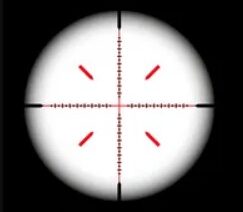
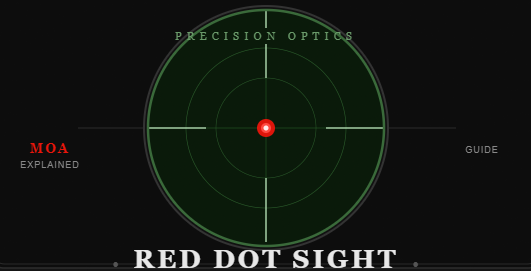
Choosing the right red dot sight can feel confusing, especially when terms like MOA appear in product specifications. MOA, or Minute of Angle, is an important measurement that helps explain a red dot’s size and potential aiming precision.
Whether you are comparing a compact 2 MOA dot with a larger 6 MOA option, understanding what the numbers mean can make your decision much easier.
In this guide, we’ll explain MOA in simple terms, show how dot size affects visibility and precision, and discuss which MOA size may suit different shooting applications.
By the end, you’ll have a clearer understanding of red dot MOA and why it matters.
“This post contains affiliate links. If you purchase through these links, I may earn a small commission at no extra cost. Learn more here.”
1–2 MOA (Smaller Dot) — Precision Pick
| Aimpoint Micro T-2 (2 MOA) | 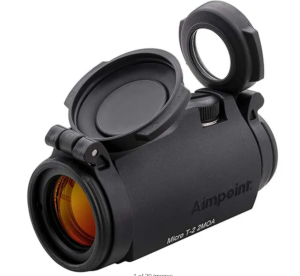 |
|
| Trijicon MRO (2 MOA) | 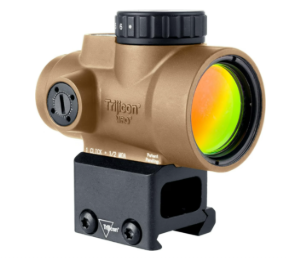 |
|
| HOLOSUN 407C/507C-X3 (2 MOA) | 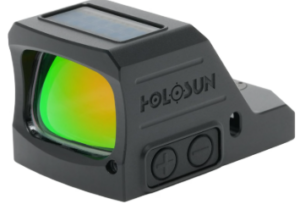 |
|
3–4 MOA (Medium Dot) — Balanced Pick
| Crimson Trace CT-RAD Pro (3 MOA) | 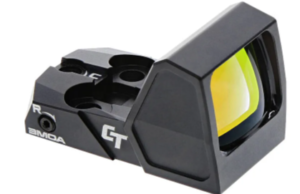 |
|
| Burris FastFire E (3.5 MOA) | 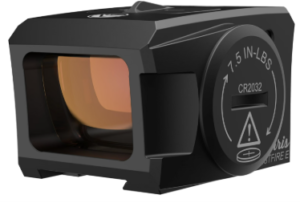 |
|
5–6 MOA (Larger Dot) — Speed Pick
| Holosun HS407K-X2 (6 MOA) | 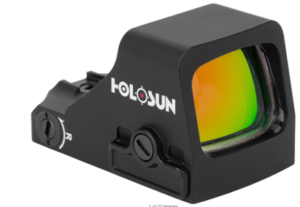 |
|
What Does MOA Mean?
MOA refers to “Minute of Angle,” which is a unit of angular measurement to gauge precision in shooting. The dot grows larger the further away it is:
One MOA is approximately 1 inch at 100 yards, 2 inches at 200 yards, etc. MOA refers to the size of the illuminated dot, NOT the bullet spread, when referring to red dot sights.
The 6 MOA dot will measure approximately 6 inches on your target at 100 yards, and the 2 MOA dot will measure approximately 2 inches on your target at 100 yards.
Smaller MOA dots will be more precise at long-range shooting positions, and larger MOA dots are quicker to pick up up close.
What Does “2 MOA” or “6 MOA” Mean?
If you see a red dot sight listed as 2 MOA, it means that the sight is 2 MOA in size on the target, not on the optic. Keep in mind that 1 MOA = approximately 1 inch at 100 yards.
Thus a 2 MOA dot will approximate 2 inches of your target at 100 yards. Compact and accurate, it is ideal for target practice, competitions or when accuracy is most important at a distance.
A 6 MOA dot, however, will represent approximately 6 inches at 100 yards. That bigger dot is easier, and quicker, to see, particularly in low light or in close up, high stress situations such as hunting fast moving game, or home defense.
MOA Comparison Table
| MOA | General appearance | Main characteristic |
|---|---|---|
| 1–2 MOA | Smaller dot | Finer aiming reference |
| 3–4 MOA | Medium dot | Balanced visibility |
| 5–6 MOA | Larger dot | More prominent reticle |
Common MOA Sizes
Red dot sights are available in a few common sizes, each of which is appropriate for a specific shooting style:
- 1-2 MOA – Very accurate, for target shooting, competition or longer distances.
- 3–4 MOA – This is a middle-ground option that offers a balance of speed and accuracy. Popular for home defense, close range shooting and for hunting fast targets,
- 6–8 MOA is larger and faster to acquire.
Some sights also have a dual-dot or multi-reticle feature, which allows you to alternate between a small, telescopic dot for accuracy and a larger dot for speed.
The size of the MOA will depend on how you are going to use it: precision shooting will require smaller dots and faster shooting or close range shooting will require larger dots.
MOA and Distance
Knowing the MOA of your red dot’s accuracy at different ranges is vital to finding the best one for you. MOA is an angular measurement, so the size of the dot on target will increase as distance increases, and will not remain a fixed physical size.
It’s about this much for a 2 MOA dot:
- At 100 yards, the dot covers about 2 inches
- At 200 yards, it covers about 4 inches
- At 300 yards, it covers about 6 inches
- At 500 yards, it covers about 10 inches
Any MOA size is scaled the same, simply multiply the MOA number by 1″ for 100″. So a 6 MOA dot will be a 6 inch circle at 100 yards, 12 inches at 200 yards and so on.
This is important because the dot may appear to be just the right size at close range but could end up blocking smaller or farther objects.
A 2 MOA dot may be hard to see on a 1/4-inch target at 300 yards while a 6 MOA dot may enclose a 1/4-inch target totally at 300 yards, making accurate firing difficult.
Understanding this relationship allows you to size your dot to the normal distance you shoot and the target size
MOA vs. Accuracy
Many people think that the smaller the MOA dot, the more accurate they are. In fact, MOA does not impact how accurately your firearm is able to shoot, but rather how accurately you are able to aim.
The size of the dot will affect the portion of your target that you will cover, which in turn will affect the amount of detail you can see around it, but the mechanical accuracy of your gun is determined by the barrel, ammunition and your own shooting technique.
However, in real-world conditions, dot size does affect the actual accuracy at distance. A smaller dot (1-2 MOA) will encompass less of the target, allowing for a more direct hit on smaller or more distant targets. This makes it easier to shoot slow and steady with precision.
The larger the dot, the greater the chance of not hitting the target and the more difficult it is to determine the accuracy of the shot. In close range or fast paced scenarios, however, larger dots will shine, as it will take your eye less time to discover and to focus on.
MOA simply doesn’t alter the potential accuracy of your gun, it just makes it easier and more accurate to take advantage of that accuracy, particularly at greater distances.
FAQs
- What does MOA stand for on a red dot sight?
MOA stands for “Minute of Angle,” a unit of angular measurement that describes how big the dot appears on your target at a given distance , not the physical size of the dot itself.
- Is a lower MOA more accurate?
Not exactly. MOA affects precision of aim, not the mechanical accuracy of your firearm. A lower MOA dot (1–2 MOA) covers less of the target, making it easier to aim precisely at small or distant points.
- What’s the best MOA for a pistol red dot?
Most shooters find 3–6 MOA ideal for pistols, since it balances fast target acquisition up close with enough precision for typical defensive or competition distances.
- What’s the best MOA for a rifle red dot?
For rifles, 2 MOA is popular for precision shooting, while 3–4 MOA works well as an all-around choice for hunting and general use
Final Thoughts
Understanding MOA is one of the easiest ways to make sense of red dot sight specifications. A smaller dot, such as 2 MOA, generally offers a more precise aiming point and can be useful when accuracy at greater distances is important.
Larger dots, such as 4 or 6 MOA, are typically easier to see quickly and may be preferable when fast target acquisition is the priority.
However, MOA is only one factor to consider when choosing a red dot sight. Brightness settings, glass quality, battery life, durability, reticle design, and the intended application can all influence your overall experience.
Ultimately, the best MOA size depends on your individual needs, visibility preferences, and shooting environment.
By understanding what MOA represents, you can compare red dot sights more confidently and select an option that matches your priorities rather than relying on the number alone.
Also check out: