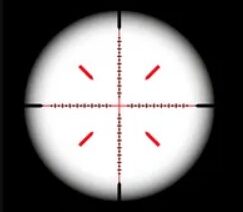
One of the major considerations for selecting a red dot sight is how far away the shooter can legally shoot with it. A red dot sight’s range is influenced by the size of the dot, its MOA, clarity of the optic, size of the target, lighting, firearm, and shooter skill.
Red dots are usually used for a 1X sight picture, unlike magnified scopes, and are great for quick target acquisition and close to medium range.
In certain cases, however, quality models can achieve high performance at large distances when they are adapted to the application.
This guide examines effective range, MOA, magnification and the characteristics to look for before deciding on one of the popular options from Aimpoint, Holosun, or Trijicon.
“This post contains affiliate links. If you purchase through these links, I may earn a small commission at no extra cost. Learn more here.”
Red Dot Sight Range
Red dot sight range refers to the distance at which a red dot remains practical and effective for aiming. While red dots are primarily designed for a fast, clear 1X sight picture, their useful range depends on factors such as MOA, target size, optic clarity, lighting, firearm, and shooter skill.
A smaller dot may offer a more precise aiming point at greater distances, while a larger dot can be faster to acquire at close range.
Understanding these factors can help you choose the right optic for your needs, whether you prefer the versatile Aimpoint Micro T-2, wide-view Holosun HS510C, compact Holosun EPS, Trijicon MRO, or competition-focused SRO.
What Is the Effective Range of a Red Dot Sight?
The distance that the red dot sight can be used effectively varies according to the type of optic used, how the gun is used, target size, lighting conditions, and the skill of the shooter.
Unlike a magnified scope, a red dot does not enlarge the target, and the practical range is affected by the shooter’s perception and ability to point and shoot at the target.
Red dots also work very well for those setups where rapid acquisition of targets is important and a large field of view is also needed in the case of medium to close range.
The quality red dot, though, can also be utilized from further away with a proper firearm and ammo. Other factors like dot size, MOA rating, glass clarity, and zero can have a big impact at greater distances.
A smaller MOA dot can give you a more accurate aiming point and a larger dot can be easier to acquire. Finally, there is no universal maximum range for red dot sights; the range that is optimal for a specific application and complete shooting setup
How Far Can You See With a Red Dot Sight?
A red dot sight can’t be considered to have a definite viewing distance as it offers an aiming point, not magnification. The distance that one can see depends on the size of the target, the light level, the quality of the optics, one’s eyesight, and the environment.
In closer range, the red dot helps you to acquire faster targets and have a wide field of view. At further distances, the target may be hard to see since the optic does not make it larger.
This is why it is a common problem of target visibility and not the illuminated dot limiting the range of red dot sight. Red dots can be used with a matching magnifier for longer distances to add more visual detail.
Best Red Dot Sights for Different Ranges
| Aimpoint Micro T-2 — Best Overall for Versatile Range | 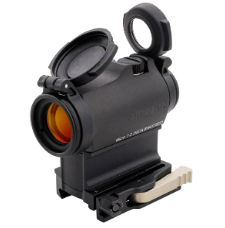 |
|
| Holosun HS510C — Best for Fast Target Acquisition | 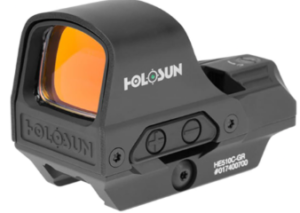 |
|
| Trijicon MRO — Best for a Larger Viewing Experience | 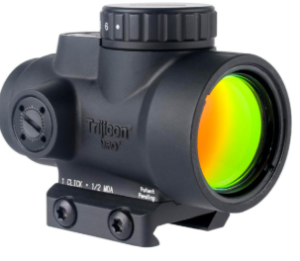 |
|
| Holosun EPS — Best Compact Pistol Option | 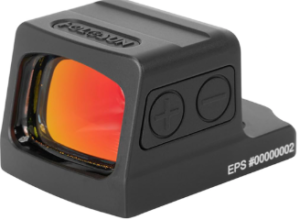 |
|
| Trijicon SRO — Best for Competition and Fast Shooting | 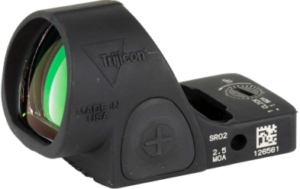 |
|
1) Aimpoint Micro T-2 — Best Overall for Versatile Range
Check Price on Amazon & Check Price on Opticsplanet
For shooters seeking a compact red dot capable of shooting at a range of practical distances the Aimpoint Micro T-2 is a wonderful option.
The 2 MOA dot gives a relatively small aiming point, and the 1X design retains that same fast, unobstructed sight picture that a red dot offers.
At a given daylight setting, the T-2 is said to have 50,000 hours of battery life, and it’s considered to be operationally parallax-free with unlimited eye relief.
T-2 is an easy pick when it comes to advocating for a red dot sight range article as it offers a good mix of durability, compactness, battery life, and accuracy.
It can also be used in conjunction with Aimpoint’s magnifiers if extra detail on the target is needed at greater distances.
Key Specs:
- 2 MOA red dot
- 1X magnification
- Unlimited eye relief
- 50,000-hour stated battery life
- CR2032 battery
- 4.6 oz with standard mount
- Waterproof to 25 meters
Pros:
- Excellent battery life
- Compact and lightweight
- Crisp 2 MOA aiming point
- Highly durable construction
- Compatible with magnifiers
Cons:
- Premium price
2)Holosun HS510C — Best for Fast Target Acquisition
Check Price on Amazon & Check Price on Opticsplanet
The Holosun HS510C focuses on speed, visibility and a large open-style viewing window to make it easy and fast for shooters who prefer such a system.
Optical system features unlimited eye relief and parallax-free performance, and the adjustable reticle can offer a 2 MOA dot, 65 MOA circle or a mixture of both. us.
The HS510C’s flexibility is another reason it’s interesting when talking about red dot sight range, as the shooter can select a reticle configuration that fits the application.
Holosun also packs in the Shake Awake tech and Solar Failsafe, and the manufacturer states that its battery life is up to 50,000 hours in dot-only mode.
Key Specs:
- 2 MOA dot and 65 MOA circle options
- 1X magnification
- Unlimited eye relief
- Solar Failsafe
- Shake Awake technology
- Up to 50,000-hour stated battery life
- IP67 waterproof rating
Pros:
- Large viewing window
- Fast dot acquisition
- Multiple reticle options
- Solar-assisted operation
- Long battery life
Cons:
- Open-emitter design
3) Trijicon MRO — Best for a Larger Viewing Experience
Check Price on Amazon & Check Price on Opticsplanet
The Trijicon MRO is a small reflex sight for rifles, carbines, and shotguns, and it has a particular emphasis on quick target acquisition.
It’s one of the company’s most notable features: it offers a larger viewing area, which accounts for the reduced “tube effect” and facilitates the easy and rapid acquisition of targets, Trijicon says.
If you are studying red dot sight range, and your optic is more important than taking a wider sight picture, the MRO may be a consideration.
Aluminum housing with 7075-T6 forged aluminum, sealed construction, multiple brightness settings and multiple coated lenses are engineered to handle demanding applications.
It can also be a good option in situations where an eventual magnifier would be added. The current MRO HD version also has a redesigned objective lens for better optical performance and magnifier compatibility.
Key Specs:
- 1X red dot optic
- Large viewing area
- 8 brightness settings on MRO models
- 2 night-vision-compatible settings
- 7075-T6 forged aluminum housing
- Sealed construction
- Waterproof design
Pros:
- Large viewing experience
- Fast target acquisition
- Rugged construction
- Excellent for rifle/carbine platforms
- Ambidextrous brightness controls
Cons:
- More expensive than many budget options
4) Holosun EPS — Best Compact Pistol Option
Check Price on Amazon & Check Price on Opticsplanet
The Holosun EPS is the perfect solution to the red dot phenomenon in a small, compact and enclosed handgun.
Holosun refers to the EPS as an “enclosed” handgun sight because it’s a full-size sight that has an aspherical lens to give a clear sight picture.
It also features the ultra-low dot height and Holosun K footprint, and includes an adapter plate for wider compatibility. The given article uses the EPS as a kind of reminder that range is a critical component of a red dot sight and is platform dependent.
Compact size, low mounting height and quick acquisition are important issues when using a pistol red dot as opposed to a rifle mounted optic.
Comes in two different reticle sizes: 2 and 6 MOA, and Holosun’s specifications include Shake Awake and on the MRS models, Solar Failsafe.
Key Specs:
- Enclosed-emitter design
- 2 MOA or 6 MOA options
- Holosun K footprint
- Aspherical glass lens
- Shake Awake technology
- 7075-T6 aluminum housing
- Ultra-low dot height
Pros:
- Enclosed design
- Clear sight picture
- Compact handgun profile
- Multiple reticle choices
- Low mounting height
Cons:
- Primarily designed for handgun applications
5) Trijicon SRO — Best for Competition and Fast Shooting
Check Price on Amazon & Check Price on Opticsplanet
Competition and target shooting are the intended applications of the Trijicon SRO, making it a perfect fit for readers who want a broad field of view and quick red dot lock-on.
According to Trijicon, the SRO is designed to give shooters the maximum field of view and a clean, crisp dot to help them shoot faster and more accurately.
For an article about a red dot sight, one of the interesting aspects of the SRO is that the markings of some of the types are actually made for use when more accuracy at distance is desired.
For instance, Trijicon now has a 1.0 MOA version and other SRO configurations have various dot sizes depending on the user’s shooting style.
Its forged aluminum 7075 housing, adjustable LED light intensity, tool-less adjustments, and large viewing area are great premium features for competitive shooters.
Key Specs:
- 1X magnification
- Wide field of view
- 1.0 MOA configuration available
- Adjustable LED brightness
- 7075-T6 forged aluminum housing
- CR2032 battery
- 3-year stated battery life on the cited 1.0 MOA model
Pros:
- Excellent field of view
- Fast target acquisition
- Multiple dot-size choices
- Competition-oriented design
- Easy adjustments
Cons:
- Premium price
What Determines Red Dot Sight Range?
Several factors determine the practical red dot sight range, including optic quality, dot size, target size, lighting, and the firearm being used.
A smaller MOA dot can provide a more precise aiming point at greater distances, while a larger dot is often easier to acquire quickly at closer ranges.
Glass clarity also becomes increasingly important as distance increases because a clear sight picture helps the shooter identify the target. The size and visibility of the target matter as well, since red dots do not provide magnification.
A proper zero, consistent ammunition, and shooter skill can further influence practical accuracy. Environmental conditions such as glare, low light, and haze may also affect visibility. Ultimately, red dot range is not determined by one specification but by how these factors work together.
What Does MOA Mean on a Red Dot Sight?
MOA, or Minute of Angle, describes the size of the aiming dot and is an important specification when considering red dot sight range.
A smaller MOA dot, such as 2 MOA, covers less of the target and can provide a more precise aiming point at longer distances. Larger dots, such as 4 or 6 MOA, are generally easier to see and acquire quickly, making them popular for close-range applications.
The right dot size depends on your intended use, target size, lighting conditions, and shooting distance. When choosing a red dot, understanding MOA helps you balance speed, visibility, and precision for your particular setup.
Red Dot Sight vs. Magnified Optic: Which Has Better Range?
| Feature | Red Dot | Magnified Optic |
|---|---|---|
| Close range | Excellent | Good |
| Speed | Excellent | Moderate |
| Magnification | No | Yes |
| Extended distance | Limited by target visibility | Better |
| Weight | Usually lighter | Usually heavier |
| Field of view | Wide | Depends on optic |
How to Choose a Red Dot Sight Based on Distance
Choosing the right red dot sight based on distance starts with understanding how you plan to use it. At close range, prioritize a wide field of view, fast target acquisition, and an easy-to-see reticle.
The Holosun HS510C is a strong option here because of its large viewing window and versatile reticle system. For handgun applications, the compact Holosun EPS provides an enclosed design and low-profile setup.
At medium distances, look for a balance of speed, clarity, durability, and dot size. The Aimpoint Micro T-2 stands out as a versatile choice, offering a fine 2 MOA dot and excellent battery life. The Trijicon MRO is another strong option when a larger viewing experience is preferred, particularly on rifles and carbines.
For competition-focused shooting, the Trijicon SRO offers a wide field of view and multiple dot-size configurations, making it suitable for shooters who value rapid target acquisition and precision. Ultimately, distance should not be the only consideration.
Your firearm, target size, lighting conditions, preferred MOA, and whether you need magnification should all influence your final choice
FAQS
- How far is a red dot sight effective?
A red dot sight does not have one fixed effective range. Its practical distance depends on the optic, dot size, target size, firearm, lighting conditions, and shooter skill. Red dots are generally most useful when fast target acquisition and a wide field of view are important.
- How far can you see with a red dot sight?
A red dot does not magnify the target, so how far you can effectively see depends largely on target size and visibility. At longer distances, identifying and aiming at a small target can become more difficult.
- Can you use a red dot sight at 100 yards?
Yes. A quality red dot can be used at 100 yards when the firearm, ammunition, optic, and target are appropriate for the application. A smaller MOA dot may provide a finer aiming point at this distance.
- Can you use a red dot sight at 200 yards?
A red dot can be useful at 200 yards, but target visibility becomes increasingly important because the optic provides no magnification. A magnifier may help when additional target detail is needed.
Final Thoughts
If you know what is meant by red dot sight range, you’ll be able to select the right optic for you and your shooting requirements.
The maximum distance is not standardized as it varies with the dot size, target, type of gun, light source, zero, and ability of the shooter.
Aimpoint Micro T-2 is versatile with excellent scope options; the Holosun HS510C delivers quick acquisition and the Trijicon MRO gives you a bigger scope.
Holosun EPS is more of an option for compact pistols that are suited for more practical applications, whereas the Trijicon SRO is a more suitable choice for competitive purposes.
Ultimately, it’s not just about range; it’s about the distance, platform, and priorities you have in mind. The combination of a properly matched optic can offer a quick, clear, and reliable aiming solution.
Also check out: